Macy’s Went Full Marshall Field’s This Year, and Honestly, It's About Time
A Holiday Homecoming to My Grandmother’s Marshall Field’s

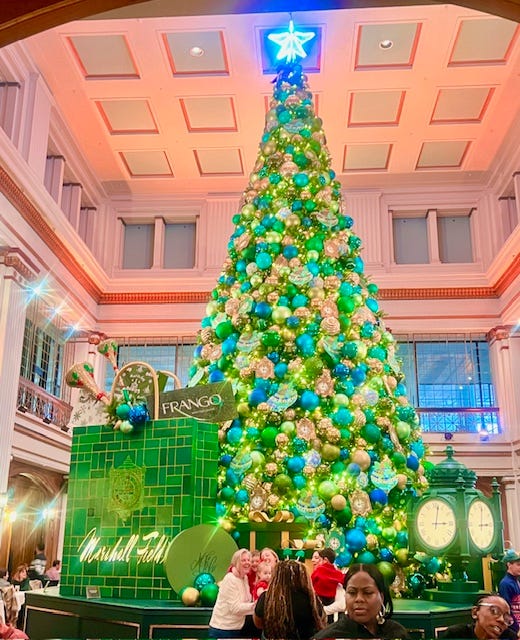
Every holiday season has one outing that feels less like shopping and more like fate in a festive sweater. For Chicagoans, that outing is Macy’s on State Street, a place that summons you back annually without ever bothering to explain itself. I’ve landed here at the tail end of November, that meteorological coin toss when Chicago chooses between snow, no snow, or “surprise, here’s both,” and you sensibly show up dressed like an onion, in layers.
Before we go any further, a quick primer for anyone not steeped in Chicago retail lore: a corporate acquisition renamed Marshall Field’s, once the grande dame of American department stores, to Macy’s in 2006. Chicagoans handled it about as gracefully as you would expect from a city with uncompromising views on hot dogs and sports rivalries confronted with the loss of a beloved institution. The red star went up, the green clocks stayed, and a good number of locals vowed lifelong boycotts with the steely resolve of people defending something sacred. Because they were.
This year, Macy’s seems to have realized that the path to Chicago’s heart runs straight through its past. They are embracing their Marshall Field’s heritage with the gusto of a long-lost friend making up for eighteen years of awkward silence. And this is no Chicago-style half-hug, the kind you give someone who looks vaguely familiar from the Metra platform. This is a full-bodied, two-armed embrace, the kind that suggests someone has finally stopped being shy about their identity.
It is frankly overdue. For years, Macy’s treated the Field’s legacy like a distant cousin who might show up to Thanksgiving with mysterious Tupperware. But this season, they have rolled out the Frango-mint-green carpet.
Still, not everyone is ready to forgive. Some Chicagoans refuse to step inside at all, maintaining their personal boycotts with the pride of knights guarding a lost kingdom. And honestly, I get it. Marshall Field’s wasn’t just a department store. It was an identity.
Walking inside feels like greeting an old friend who has had some tasteful cosmetic upgrades. Still familiar. Still beloved. Suddenly lit like an influencer. Marshall Field’s was the store my family dressed up for. And I mean dressed up. Patent leather shoes. Serious coats. Outfits with structure, intention, and maybe a little starch. You did not just shop at Field’s. You paid your respects.
And then there is the real pilgrimage: the Walnut Room on the seventh floor.
This year’s theme is pure, unfiltered Marshall Field’s, and it hit me right in the sentimental solar plexus. My grandmother, Josephine O’Connor who was born on Christmas Day 1900, worked as a waitress in the Walnut Room from around 1915 into the early 1920s. I picture her weaving through the dining room with trays of chicken pot pies and coffee, moving faster than I ever have in my life. The Great Tree would have been glowing.
The Walnut Room today is still magical. The wood paneling gleams. The lights shimmer. The Great Tree stands there as if it owns Christmas. Families gather beneath it. Some people are dressed like they are going to a winter gala. Others look as if they wandered in on the way home from yoga. No judgment. My grandmother would have judged enough for all of us.
On this visit, I lingered. Maybe it was nostalgia. Maybe it was the feeling that my grandmother’s footsteps were not as far ahead of mine anymore. Maybe it was seeing Macy’s finally embrace what Chicago has always known. These floors hold stories. Generations of them. Mine is just one.
If you grew up in Chicago, you know some places do not simply store memories. They archive entire family histories. And regardless of the text on the shopping bags, Marshall Field’s still lives on here—in this building, in this city, and in everyone who once dressed up for an afternoon on State Street.
Author’s Note
Born and raised in Chicago, I’ve always believed the city’s history lives as much in its people as in its buildings, especially those with Great Trees.
I’m writing a historical fiction novel about Bertha Honore Palmer, a remarkable Chicago woman of the Gilded Age. Hopefully, by this time next year, her story will be in print—and in your hands.
Love this article, Siobhan.
I still call it Marshall Field’s!